
Sunday, May 25, 2014
A Stack of Plastic Chairs

Thursday, May 15, 2014
Reports (etc.)!

It’s been a little while since I wrote a blog
post and that’s because for this is the time of the month that we gather and
record attendance and assignment reports. When they are finally all assembled
(not an easy task) I start inputting for the 25 or so programs that we
coordinate here in Johannesburg. I have also been helping with the reports for
the Botswana Stake and the Botswana/Namibia mission since they presently have
no coordinator in the Botswana mission. Picking up reports, making calls or
sending multiple texts and emails requesting them can be challenging and
sitting at a computer filling in spaces is not the most rewarding part of our
mission but we recognize that it is part of the total effort to strengthen the
young people of the Johannesburg mission. As I’m clicking away, I remind myself
that if a seminary or institute student goes through the effort that they need
to get to a class, especially here, then they deserve to have their attendance
recorded and eventually be rewarded with seminary graduation or with a certificate
for institute. I like a quote by Elder Henry B. Eyring when he said “Never, never underestimate the spiritual
value of doing temporal things well for those whom you serve.” That same attitude
could be applied to other areas of our life—often mechanical, routine activities
are necessary to accomplish meaningful goals like raising family—the big
picture may be developing happy, contributing adults but part of that effort
includes doing the laundry :)
Wednesday, May 7, 2014
South African Goes to the Polls

Today is voting day in South
Africa so another holiday of course (sometime I’ll write a post about the
number of public holidays in South Africa!) If it were election day in America,
we would be deciding between the Democrats, the Republicans and maybe the Independents.
Here people have their choice of candidates from the ANC or African National
Congress; the ACDA or African Christian
Democratic Party, The APC or African People’s Convention, the AZAPO or
Azanian People’s Organization; COPE or Congress of the People, the DA or Democratic Alliance; The FF+ or
Freedom Front+; the MF or Minority Front; the ID of Independent Democrats; The
IFP or Inkatha Freedom Party; the PAC or Pan Africanist Congress; the SACP or
South African Communist Party; the UCDP or United Christian Democratic Party or
the UDM or United Democratic Movement. Those are just the parties that are
represented in the South African Congress. If a voter can’t make up their mind
from among those, there are another 70 or so parties that are registered and
active but not yet represented in congress. We are told that the sheer number of parties is a problem because the
votes are so split (you think? J) You would wonder how a decision is ever reached
unless you look at the seats in congress. From the latest information I could
find, the ANC or African National Congress has about 70% of the seats in
congress with the other 30% being divided among all of the other 14 or so
parties. The DA, which is the closest contender, has only about 16%. As you
might guess, the majority party has traditionally been the black party, which
would be expected since the black population far outnumbers the whites. The DA
has been traditionally the white Afrikaans party, but both parties through
times have been astute enough to gather members and supporters of all
ethnicities, so now, at least in theory, it has become more a contest of
political ideals than races. We have seen political advertisements showing
people of all ethnicities. Interestingly, one of the faces looks very much like a slightly older version of Sarah Palin and I have read a commentary comparing her to Palin in other unflattering ways.

As the parties have been
vying for voters, among the tactics used have been threats and intimidation with
demonstrations and even some rioting leading up to voting day. Because of that,
we are having an at home day, not wanting to get in the middle of any political
squabbles. Hopefully there will also be great celebrations, since this is the 20th anniversary the end of apartheid and the beginning of democracy where of all people being able to vote in the
country.
Monday, May 5, 2014
Johannesburg Botanical Garden
Today we decided to take a “P” day (preparation day) but we
didn’t really prepare for anything. We just went and played for the day with
some other senior couples. We went to the Johannesburg Botanical Garden, which is a big park right in the middle of the city. Since it was a weekday and not
really the garden time of the year, we had the park almost to ourselves. Most
of the area is quite informal and in the more formal part, the roses are almost
gone. They had a few pieces of rustic art that were nice and it was fun just to
walk around and enjoy the pretty autumn day (here in our part of the world J)


Wednesday, April 30, 2014
Johannesburg Architecture
Johannesburg is a city of contrasts, and architecture is no exception. Here are some photos of some of the shiny, the dusty, the modern, the old, and I think the most interesting to me--the once shiny and new but now old and dusty. For example, the Vodacom building must have been a state of the art technical hub at one time but has been humbled through the years to a high density apartment building with satellite dishes bristling from almost every window. I can't imagine what happens when elevators stop working for any reason as they often do in the older part of town. I would love to see a time lapse movie of the evolution of this city.


Wednesday, April 23, 2014
Lesedi Village

One of the places we wanted to be sure to go to here in Johannesburg is Lesedi village. It is set up as a cultural experience on the order of the BYU Cultural Center in Hawaii, but not nearly as slick or elaborate. Still it was a very nice experience where guides take you through forest area in which small villages are set up to represent each of the main five tribes including Zulu, Xhosa, Pedi, Basotho and Ndebele. They claim that families actually live permanently in each of the homesteads, but they didn’t look quite lived in enough to convince me of that. Guests could actually rent the little houses and stay in them though which would be fun. They also have a much fancier part of the village but we went only the cultural center part.
We actually went on this adventure a while ago, but I waited to post it until now. The PegBuddy families of all of my children have now accompanied us to some African location except for Tim’s family so I wanted to make this post in order, but I wanted his family to go to Lesedi because Sydney worked at the Polynesian Cultural Center when she went to BYU. Syd, even though they didn’t have quite the same kind of dancing that you did there, I’m sure they would have found you a spot somewhere in their production. The performers all seemed to really enjoy what they were doing. I wish their energy could be attached to the pictures.


 |
| Oliver helped with the drumming |

 |
| Baby Peter |
 |
| Our new flat |
 |
| Sydney wanted to move into this little house. |
 |
| All of the Tim Davie Family with some of the resident vendors, happy because I bought some things to send home. |
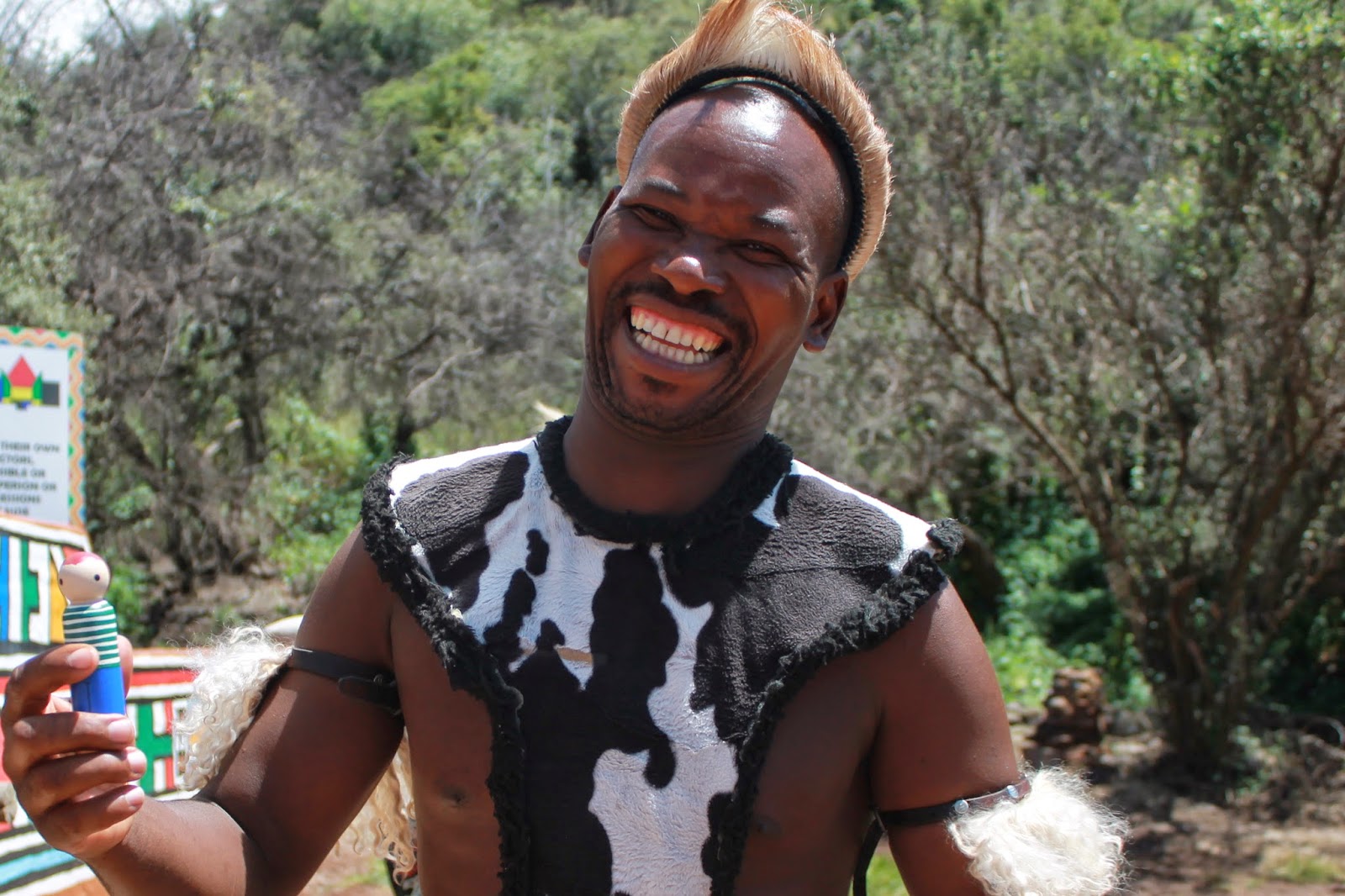 |
| This guy loved the PegBuddies; you can tell that he was delighted to have his photo taken with Tim. |
Friday, April 18, 2014
Day to Day


Here’s a
little post on what we do from day to day as Church Education System
missionaries. I’m sure that these patterns would vary somewhat from one CES
mission to another, but many of our activities would be common for such
missions.
We get up
each morning at about 6:00 and go for a walk for about an hour, come home and
have breakfast (Elder Davie is always the breakfast cook just as he was at
home.) Sometimes we study in the morning together, but we usually do it later
in the day. At about 8:00, we leave to go the CES office, which is on the same
grounds as the MTC training center in Roodepoort. We are not required to be at
the office, but because we don’t have a reliable Internet connection at home,
and since so much of our work is done online, we need the Internet. Also, that
is the way we keep in touch with our family so we do most of that there as
well. We do have a mobile wi-fi that we use at home. Sometimes it works quite
well and other times it is in and out. They are building a new cell tower at
the end of our street so hopefully that will help. The data is also purchased
in a pay-as-you-go system. It’s expensive and it often runs out when we don’t
expect it. At the office, we set up seminary and institute classes in an online
record keeping system called WISE. In WISE we record names, attendance and
assignments completed for home study students.
As you
would expect, the system can only find students by the name recorded in church
records. Just trying to read their names can be a puzzle because records are
almost always handwritten, sometimes badly, and because we are just not used to
the letter combinations possible with tribal based names. Students often have
several names, which can be a mixture of African and English, and then they may
use none of those but instead a nickname that they have gone by all of their
lives, sometimes so long that they have no idea what their name is on the
church records. So some are difficult to find because of that and others may
not have their records in the stake. I still have a number of names in those
categories that I’m trying to do some detective work.
Often the
most difficult part of recording is actually getting the records. Some teachers
are just not used to doing administrative work as part of a calling, but others
have a challenge in getting records to us. They don’t have access to computers
or scanners or even phones that can snap pictures and send them, so a few of
the records are picked up in person. Others just take lots of reminding. We are
also responsible for making sure teachers have the books and supplies they need
to teach their classes so there is some messenger work in that way.
One of the
great challenges in our area is transportation—distances are great and many
teachers and students rely on taxis or combies to get anywhere. They are not
sedan type taxis like in the states, but usually twelve or 15 passenger vans
that are stuffed with half again as many riders as will fit. Because of
transportation, we give three separate in-services during the month to try to
help teachers learn to teach in a way that involves the student in learning and
teaching so that they become independent learners and not only know information
but understand principles and doctrines and will hopefully choose to apply them
in their lives. During parts of the month, preparation for and presentation of
those classes take up a good part of our time.
A little
side responsibility is inspecting the flats (apartments) of the full time
missionaries. That only takes a couple days out of our month and it is fun to
meet the young elders and see how they’re doing. There are no sister
missionaries in Johannesburg because the country is not considered safe enough
for the young women to be out unaccompanied in villages and townships as they
would need to be. In every case except one, the apartments have been well cared
for. We’ll go next week and see if the questionable one has improved.
Saving the
best till last in this overview of our work here, I’ll say that the part we
enjoy the most is going to visit the classes and meeting the kids. Right now we
have eighteen seminary programs and seven institute programs that we visit. We
like kids wherever they are in the world, but seeing the challenges that a lot
of these young people face and how they are still happy and hopeful and progressing
really humbles you. Also being in the classroom settings that vary from the
typical chapel classroom to the humblest of homes is such a dramatic
illustration that things don’t really matter that much. Some of these young
learners would impress anyone with their knowledge and their drive to progress.
We just pray for their country, that jobs and opportunities will be there for
these young people. There are several programs here that are meant to support
that, and we are just learning about a new more orchestrated effort that is
being developed that may help young church members find pathways to education
and jobs. We will have a small role in that effort and look forward to learning
more.
So that is
a little overview of what we are doing day to day when we’re not posting but
just working--recording, requesting, planning, teaching, driving, inspecting,
administrating, visiting, supporting and best of all learning.
Subscribe to:
Posts (Atom)